Shekalim 7b: Talmud study for Daf Yomi
Study the Talmud for Daf Yomi with scanned pages, Hebrew text, English translations from Sefaria and AI-generated French translations.
Passage selection and English or AI-generated French translation are available where the scan has annotations. Daf Study is independent of Torah-Box and Sefaria.
Browse Shekalim · שקלים · All tractatesShekalim 7b text and translations
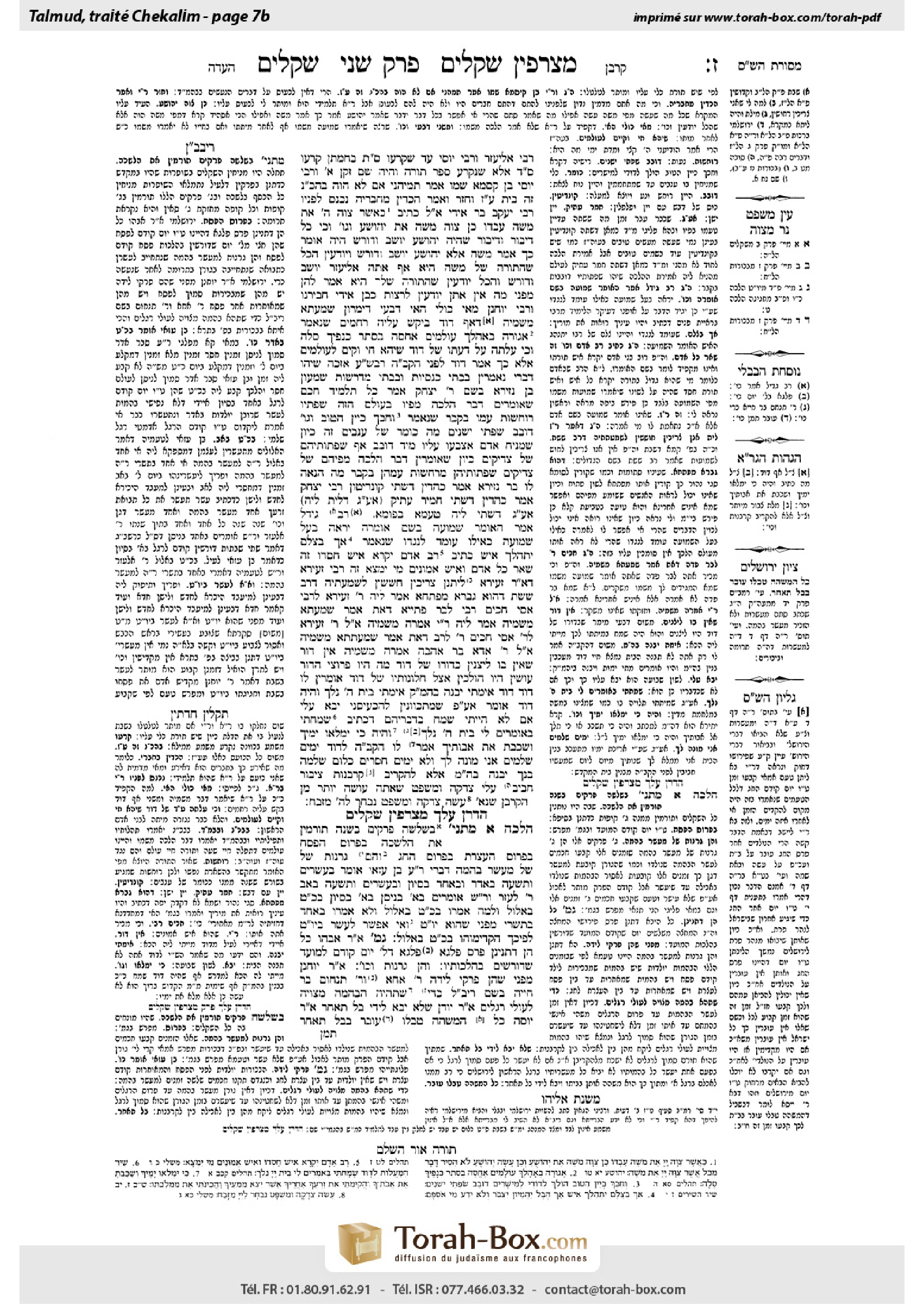
This page of Shekalim includes the Aramaic text and an English translation, alongside the scan above.
שקלים ז׳ ב · Aramaic and Hebrew text
[רִבִּי יוֹחָנָן הֲוָה מַסְמִיךְ וְאָזִיל עַל רִבִּי חִיָיא בַּר אַבָּא וַהֲוָה רִבִּי אֱלִיעֶזֶר חֲמִי לֵיהּ וּמִטַּמֵּר לֵיהּ מִקַּמֵּי וַאֲמַר. הָלֵין תַּרְתֵּין מִילַּיָּא הָדֵין בַּבְלָאָה עֲבִיד בֵּיהּ. חָדָא דְלָא שְׁאִיל בִּשְׁלוֹמֵיהּ וְחָדָה מִיטָּמַר. אֲמַר לֵיהּ רִבִּי יַעֲקֹב בַּר אִידִי כָּךְ נַהֲגִין גַּבְּהוֹן. זְעִירָא לָא שְׁאִיל בִּשְׁלוּמֵיהּ דְּרַבָּה. דְּאִינּוּן נְהִגִין וּמְקַיְימִין רָאוּנִי נְעָרִים וְנֶחְבָּאוּ וִישִׁישִׁים קָמוּ עָמָדוּ. אֲמַר לֵיהּ. מָהוּ לְמֵיעֲבַד קַמֵּי דַאֲרוּרָא צִילְמָא. אֲמַר לֵיהּ. מַה אַתְּ פְּלִיג לֵיהּ יְקָר. עֲבוֹר קַמּוֹהִי וְסַמִּי עֵינוֹיי. אֲמַר לֵיהּ. יְאוּת רִבִּי אֱלִיעֶזֶר עֲבוּד דְּלָא עֲבַר קַמָּךְ. וְעוֹד עֲבִיד הָא בַּבְלָאָה דְלָא אֲמַר שְׁמַעְתָּא מִשְּׁמֵיהּ. נִכְנְסוּ לְפָנָיו רִבִּי אִמּי וְרִבִּי אַסִּי. אָמְרוּ לוֹ. רִבִּי. כָּךְ הָיָה מַעֲשֶׂה בֵּית הַכְּנֶסֶת שֶׁל טַרְסִיִּים הָיָה בְּנַגָּר שֶׁיֵּשׁ בְרֹאשׁוֹ גְלוּסְטְרָא. שֶׁנֶּחְלְקוּ רִבִּי אֶלְעָזָר וְרִבִּי יוֹסֵי עַד שֶׁקָּרְעוּ סֵפֶר תּוֹרָה בָחַמָּתָן. וְקָרְעוּ סַלְקָָא דַּעְתָּךְ. אֶלָּא שֶׁנִיקְרַע סֵפֶר תּוֹרָה. וְהָיָה שָׁם זָקֵן אֶחָד. וְרִבִּי יוֹסֵי בֶּן קִיסְמָא. אָמַר. תְּמוֹהָנִי אִם לֹא הֲוָה בֵּית הַכְּנֶסֶת זֵה עֲבוֹדָה זָרָה. וְחָזַר וְאָמַר. הָכְדֵין מֵחַבְרֵיהּ. נִיכְנַס לְפָנָיו רִבִּי יַעֲקֹב בַּר אִידִי. אָמַר לוֹ כְּתִיב כָּל אֲשֶׁר צִוָּה יְי אֶת מֹשֶׁה עַבְדּוֹ כֵּן צִוָּה יְהוֹשֻׁעַ וגו׳. וְכִי כָל דִּיבּוּר וְדִיבּוּר שֶׁהָיָה יְהוֹשֻׁעַ יוֹשֵׁב וְדוֹרֵשׁ הָיָה אוֹמֵר. כָּךְ אָמַר מֹשֶׁה. אֶלָּא יְהוֹשֻׁעַ יוֹשֵׁב וְדוֹרֵשׁ וְיוֹדְעִין שֶׁהַתּוֹרָה שֶׁל מֹשֶׁה הִיא. אַף אַתָּה אֶלְעָזָר יוֹשֵׁב וְדוֹרֵשׁ. הַכֹּל יוֹדְעִין שֶׁתּוֹרָה שֶׁלָּךְ הִיא. אָמַר לָהֶן. מִפְּנֵי מַה אֵי אַתֵּם יוֹדְעִין לָרַצּוֹת כְּבֶן אִידִי חֲבֵירֵינוּ.
וְרִבִּי יוֹחָנָן מַאי כוּלֵּי הַאי. דְּבָעֵי דְּיֵימְרוּן שְׁמַעְתָּא מִשְּׁמֵיהּ. דְּאַף דָּוִד בִּיקֵּשׁ עָלֶיהָ רַחֲמִים. שֶׁנֶּאֱמַר אָגוּרָה בְאָהָלְךָ עוֹלָמִית אֶחֱסֶה בְסֵתֶר כְּנָפֶיךָ סֶּלָה. וְכִי עָלְתָה עַל דַּעְתוֹ שֶׁל דָּוִד שֶׁיְּהֵא חַי וְקַיָים לְעוֹלָמִים. אֶלָּא כָךְ אָמַר דָּוִד לִפְנֵי הַקָּדוֹשׁ בָּרוּךְ הוּא. רִבּוֹנוֹ שֶׁל עוֹלָם. אֶזְכֶּה שֶׁיְּהוּ דְבָרַיי נֶאֱמָרִין בְּבָתֵּי כְנֶיסִיּוֹת וּבָתֵּי מִדְרָשׁוֹת. שִׁמְעוֹן בֶּן נְזִירָא בְשֵׁם רִבִּי יִצְחָק אָמַר. כְּל תַּלְמִיד חָכָם שֶׁאוֹמְרִים דְּבַר הֲלָכָה מִפִּיו בָעוֹלָם הַזֶּה שְׂפָתָיו רוֹחֲשׁוֹת עִמּוֹ בַקֶּבֶר. שֶׁנֶּאֱמַר דּוֹבֵב שִׂפְתֵי יְשֵׁינִים. מַה כֹמֶר שֶׁל עֲנָבִים זֶה כֵּיוָן שֶׁמַּנִּיחַ אָדָם אֶצְבָּעוֹ עָלָיו מִיַּד דוֹבֵב אַף שִׂפתּוֹתֵיהֶם שֶׁל צַדִּיקִים כֵּיוָן שֶׁאוֹמְרִין דְּבַר הֲלָכָה מִפִּיהֶם שֶׁל צַדִּיקִים שִׂפְתּוֹתֵיהֶן מְרַחֲשׁוֹת עִמָּהֶן בַקֶּבֶר. מַה הֲנְָאָה לוֹ. בַּר נְזִירָא אָמַר. כְּהָדֵין דְּשָׁאתֵי קוֹנְדִּיטוֹן. רִבִּי יִצְחָק אָמַר. כְּהָדֵין דְּשָׁאת חֲמַר עָתִיק. אַף עַל גַּב דְּלֵית לֵיהּ טַעֲמָא.
גִּדּוּל אָמַר. כָּאן שְׁמוּעָה בְשֵׁם אוֹמְרָהּ יִרְאֶה בַּעַל שְׁמוּעָה כְּאִילּוּ עוֹמֵד לְנֶגְדּוֹ. שֶׁנֶּאֱמַר אַךְ בְּצֶלֶם יִתְהַלֶּךְ אִישׁ. רוֹב אָדָם יִקְרָא אֶת אִישׁ חַסְדּוֹ. זֶה שְׁאָר כָּל אָדַם. וְאִישׁ אֱמוּנִים מִי יִמְצָא. זֶה רִבִּי זְעִירָא. דְּאָמַר רִבִּי זְעִירָא. לָמָּה לִי שֶׁאֲנִי צְרִיכִין רְחוּשִׁין לִשְׁמַעְתֵּיהּ דְּרַב שֵׁשֶׁת דְּהוּא גַבְרָא מְפַתְחָא. אֲמַר לֵיהּ רִבִּי זְעִירָא לְרִבִּי אַסִּי. חֲכִים רִבִּי לְבַר פַּתְיָיה דְאָתָא אֲמַר שְׂמוּעָתָא מִשְּׁמֵיהּ. אֲמַר לֵיהּ רִבִּי יוֹחָנָן אָמְרָהּ מִשְׁמֵיהּ. אֲמַר לֵיהּ רִבִּי זְעִירָא לְרִבִּי אַסִּי. חֲכִים רִבִּי לְרַב דְאַתּ אֲמַר שְׂמוּעָתָא מִשְּׁמֵיהּ. אֲמַר לֵיהּ. רַב אָדָא בַּר אַהֲבָה אָמְרָן מִשְּׁמֵיהּ.
אֵין דּוֹר שֶׁאֵין בּוֹ לֵיצָנִין. בְּדוֹרוֹ שֶׁל דָּוִד מֶה הָיוּ פְרוּצֵי הַדּוֹר עוֹשִׂין. הָיוּ הוֹלְכִים אֶצֶל חֲלוֹנוֹתָיו שֶׁל דָּוִד. אוֹמְרִין לוֹ. דָּוִד דָּוִד. אֵימָתַי יִבָּנֶה בֵית הַמִּקְדָּשׁ. אֵימָתַי בֵּית יי נֵלֵךְ. וְהָיְה דָּוִד אֹמֵר. אַף עַל פִּי שֶׁמִתְכַּוְונִין לְהַכְעִיסֵנִי יָבֹאוּ עָלַי אִם לֹא הָיִיתִי שָׂמֵחַ בְדִבְרֵיהֶם. דִּכְתִיב שָׂמַחְתִּי בְּאוֹמְרִים לִי בֵּית יְהֹוָה נֵלֵךְ. וְהָיָה כִּי יִמְלְאוּ יָמֶיךָ וְשָׁכַבְתָּ עִם אֲבוֹתֶיךָ. אָמַר לוֹ הַקָּדוֹשׁ בָּרוּךְ הוּא לְדָוִד. יָמִים שְׁלֵמִים אֲנִי מוֹנֶה לְךָ וְלֹא יָמִים חֲסֵרִים. כְּלוּם שְׁלֹמֹה בִנְךָ יִבְנֶה בֵית הַמִּקְדָּשׁ אֶלָּא לְהַקְרִיב קָרְבְּנוֹת צִבּוּר. חָבִיב עָלַי צְדָקָה וּמִשְׁפָּט שֶׁאַתָּה עוֹשֶׂה יוֹתֵר מִן הַקָּרְבַּן. שֶׁנֶּאֱמַר עֲשֶֹׂה צְדָקָה וּמִשְׁפָּט נִבְחָר לַה׳ מִזָּבַח.]
משנה: בִּשְׁלשָׁה פְּרָקִים בַּשָּׁנָה תּוֹרְמִין אֶת הַלִּשְׁכָּה בְּפַרְס הַפֶּסַח בְּפַרְס עֲצֶרֶת בְּפַרְס הֶחָג וְהֵן גְּרָנוֹת שֶׁל מַעְשַׂר בְּהֵמָה דִּבְרֵי רִבִּי עֲקִיבָה. בֶּן עַזַּאי אוֹמֵר בְּעֶשְׂרִים וְתִשְׁעָה בַּאֲדָר בְּאֶחָד בְּסִיוָן בְּעֶשְׂרִים וְתִשְׁעָה בְּאָב. רִבִּי לָעְזָר וְרִבִּי שִׁמְעוֹן אוֹמְרִים בְּאֶחָד בְּנִיסָן בְּאֶחָד בְּסִיוָן בְּעֶשְׂרִים וְתִשְׁעָה בֶּאֱלוּל. וְלָמָּה אָמְרוּ בְּעֶשְׂרִים וְתִשְׁעָה בֶּאֱלוּל וְלֹא אָמְרוּ בְּאֶחָד בְּתִשְׁרֵי מִפְּנֵי שֶׁהוּא יוֹם טוֹב וְאֵי אֶפְשָׁר לְעַשֵּׂר בְּיוֹם טוֹב לְפִיכָךְ הִקְדִּימוּהוּ בְּעֶשְׂרִים וְתִשְׁעָה בֶּאֱלוּל:
הלכה: בִּשְׁלשָׁה פְּרָקִים בַּשָּׁנָה כוּל׳. אָמַר רִבִּי אַבָּהוּ. כָּל הֵן דְּתַנִּינָן פַּרְס פַּלְגָא. [פַּלְגָּא בִשְׁלֹשִׁים יוֹם קוֹדֶם לַמּוֹעֵד שֶׁדּוֹרְשִׁין בְּהִלְכוֹתָיו.]
אָמַר רִבִּי יוֹחָנָן. מִפְּנֵי שֶׁהֵן פִּירְקֵי לֵידָה. רִבִּי אָחָא רִבִּי תַנְחוּם בַּר חִיָיה בְשֵׁם רִבִּי יְהוֹשֻׁעַ בֶּן לֵוִי. כְּדֵי שֶׁתָּהֵא בְהֵמָה מְצוּיָה לְעוֹלֵי רְגָלִים. אְמַר רִבִּי יוּדָן. שֶׁלֹּא יָבוֹא לִידֵי בַּל תַּאַחֵר. אָמַר רִבִּי יוֹסֵה. כָּל הַמַּשְׁהֶא טִיבְלוֹ עוֹבֵר. תַּמָּן תַּנִּינָן. רַבִּי מֵאִיר אוֹמֵר. בְּאֶחָד בֶּאֱלוּל רֹאשׁ הַשָּׁנָה לְמַעְשַׂר בְּהֵמָה. בֶּן עַזַּיי אוֹמֵר הָאֱלוּלִיִּים מִתְעַשְּרִין בִּפְנֵי עַצְמָן. אָמַר רִבִּי חוּנָה. טַעֲמֵיהּ דְרִבִּי מֵאִיר. עַד כָּאן הֵן מִתְמַצּוֹת לֵילֵד מְן הַיְּשָׁנוֹת. מִיכָּן וְאֵילָךְ הֵן מַתְחִילוֹת לֵילֵד מִן הַחֲדָשׁוֹת. רִבִּי יוֹסֵה בֵּירִבִּי בּוּן בְּשֵׁם רַב חוּנָה. טַעֲמֵיהּ דְּרִבִּי אֶלְעָזָר וְרִבִּי שִׁמְעוֹן. לָבְשׁוּ כָרִים הַצֹּאן אֵילּוּ הַבְּכִירוֹת. וַעֲמָקִים יַעַטְפוּ בָר אֵילּוּ הָאֲפֵילוֹת. יִתְרוֹעֲעוּ אַף יָשִׁירוּ. אֵילּוּ וָאֵילּוּ נִכְנָסִין לַדִּיר לְהִתְעַשֵּׂר. אָמַר בֶּן עַזַּאי. הוֹאִיל וְאֵילּוּ אוֹמְרִים כָּךְ וְאֵילּוּ אוֹמְרִים כָּךְ יְהוּ הָאֱלוּלֵיִים מִתְעַשְּרִין בִּפְנֵי עַצְמָן. הָא כֵיצַד. נוֹלַד לוֹ בַחֲמִשָּׁה בְאַב וַחֲמִשָּׁה בְאֱלוּל וַחֲמִשָּׁה בְתִשְׁרֵי אֵין מִצְטָרְפִין. נוֹלַד לוֹ חֲמִשָּׁה בְאַב וַחֲמִשָּׁה בְתִשְׁרֵי הֲרֵי אֵילּוּ מִצְטָרְפִין. וּבֶן עַזַּאי מַכְרִיעַ עַל דִּבְרֵי תַלְמִידָיו. רִבִּי יִרְמְיָה רִבִּי מַיְישָׁא בְשֵׁם רִבִּי שְׁמוּאֵל בַּר רַב יִצְחָק. שֶׁכֵּן נֶחְלְקוּ עָלֵיהָ אָבוֹת הָעוֹלָם. מָאן אִינּוּן אָבוֹת הָעוֹלָם. תַּנָּא רִבִּי יוֹנָה קוֹמֵי רִבִּי יִרְמְיָה. רִבִּי יִשְׁמָעֵאל וְרִבִּי עֲקִיבָה. זֹאת אוֹמֶרֶת. בֶּן עַזַּאי חָבֵר וְתַלְמִיד הָיָה דְרִבִּי עֲקִיבָה. אִין תֵּימַר רַבֵּיהּ. אִית בַּר נַשׁ אֲמַר לְרַבֵּיהּ. הוֹאִיל וְאֵילּוּ אוֹמְרִים כָּךְ וְאֵילּוּ אוֹמְרִים כָּךְ. רִבִּי אָבוּן בְּשֵׁם רִבִּי שְׁמוּאֵל בַּר רַב יִצְחָק שָׁמַע לָהּ מִן הָדָא. אָמַר לוֹ בֶּן עַזַּאי. עַל חֲלוּקִין אֲנוּ מִצְטָעֲרִין אֶלָּא שֶׁבָּאתָה לַחֲלוֹק עָלֵינוּ אֶת הַשָּׁוִין. זֹאת אוֹמֶרֶת. בֶּן עַזַּאי חָבֵר וְתַלְמִיד הָוָה לְרִבִּי עֲקִיבָה. אִין תֵּימַר רַבֵּיהּ. אִית בַּר נַשׁ אֲמַר לְרַבֵּיהּ. אֶלָּא שֶׁבָּאתָ לַחֲלוֹק עָלֵינוּ.
Shekalim 7b · English translation
2:1 (Notes 53–67) and Mo`ed Qaṭan3:7 (83c l. 40–83d l. 8). Rebbi Joḥanan was leaning on Rebbi Ḥiyya bar Abba when Rebbi Eliezer saw him and hid himself before him. He said, these two things the Babylonian does to me: First, that he does not greet me, and second, that he hides himself. Rebbi Jacob bar Idi said to him, thus they behave among themselves; Rebbi Ze`ira did not greet Rabba since they observe29:8. Boys see me and hide themselves; elders rise and stand. He asked him, may one pass by a cursed statue? He said to him, do you want to honor it? Pass it by and blind its eyes! He said to him, Rebbi Eliezer did well that he did not pass before you. The other thing the Babylonian does, that he does not mention my tradition in my name. Rebbi Immi and Rebbi Assi came to him. They said to him, Rabbi, so it happened that it was a synagogue of weavers, about a bolt topped by a lock10:9. about which Rebbi Eleazar and Rebbi Yose disagreed until they tore a Torah scroll in their rage. Would you think that they tore a Torah scroll? But that a Torah scroll was torn. There was an old man there, Rebbi Yose ben Qisma, who said, I wonder whether this synagogue will not be a place of foreign worship. He came back and asked, where is the colleague? Rebbi Jacob bar Idi came and said to him, it is written. 11:15., all that the Eternal commanded to His servant Moses so Joshua commanded. When Joshua explained, did he mention every time “so said Moses”? No, he explained and they knew that it was Moses’s teaching. So also Eleazar sits and explains and everybody knows that it is your teaching. He said to them, why do you not know to pacify like our colleague Ben Idi?
Why did Rebbi Joḥanan insist to require that traditions should be reported in his name? For also David begged for divine mercy in this respect, as it says, may I dwell in Your tent forever, I shall seek shelter under the cover of Your wings, Selah 61:5.. Could David think of living forever? Rather, David said before the Holy One, praise to Him: Master of the World, may I have the merit that my words will be mentioned in synagogues and houses of study. What good does that do to him? Simeon, the son of the Nazir said in the name of Rebbi Isaac If a Sage’s pronouncement in matters of practice is mentioned in this world, the latter’s lips whisper with him in the grave for it is said means “to speak”., dripping from the lips of the sleeping ones. Like that softened bunch of grapes, if a person puts his finger on it immediately it drips, so also the lips of the just drip, for if one mentions their pronouncements in matters of practice the latter’s lips whisper in the grave. What good does that do to them? The son of the Nazir says, like one who drinks spiced wine; Rebbi Isaac said, like one who drinks old wine, even though he cannot taste it.
1, Notes 188–191. Giddul said, anybody who quotes somebody should consider it as if the author of the quote stood before him, for it is said 39:7., only in image a man wanders. It is written. 20:6. many a man professes good will, this is the rest of mankind; but where will you find one you can trust, that is Rebbi Ze`ira. As Rebbi Ze`ira said, should we take the traditions of Rav Sheshet into account since he is blind? Rebbi Ze`ira said to Rebbi Assi, does the Rabbi know Bar Petaiah that you quote traditions in his name? He said to him, Rebbi Joḥanan quoted them in his name. Rebbi Ze`ira said to Rebbi Assi, does the Rabbi know Rav that you quote traditions in his name? He said to him, Rebbi Ada bar Ahavah quoted them in his name.
and Mo`ed Qaṭan. There is no generation without scoffers. What did the hooligans of David’s generation do? They went to David’s windows and said to him: David, when will the Temple be built, when will we go to the Eternal’s house? David said, even though they intend to enrage me, something should come over me were I not happy, I enjoy it when they say to me: let us go to the Lord’s house 122:1.. When your days will be complete and you will lie with your forefathers 7:12.. The Holy One, praise to Him, said to David:, I am counting full days for you, I am not counting missing days for you. Will not your son Solomon build the Temple for public sacrifice? Law and justice that you are upholding is more to my liking than sacrifices, as it is said. 21:3., upholding justice and law is preferred by the Eternal to sacrifice.]
MISHNAH: Three times a year one disburses from the lodge were stored, to be disbursed as will be described in Mishnah 2.; half a month before Passover, half a month before Pentecost, and half a month before Tabernacles, and these are threshing floors for animal tithe, the words of Rebbi Aqiba. Ben Azzai says, on the 29 of Adar, the festive Passover Eve., the first of Sivan4, and the 29 of Av. Rebbi Eleazar and Rebbi Simon say, on the first of Nisan, the first of Sivan, and the 29 of Elul. Why did they say on the 29th of Elul and did not say on the first of Tishre? Because that is a holiday and it is impossible to tithe on a holiday; therefore they advanced it to the 29 of Elul.
HALAKHAH: “Three times a year,” etc. Rebbi Abbahu said, everywhere we have stated pars, it is one half“a part” means one part of two; in this case of the month preceding the holiday.. [Half of the thirty days before a holiday when one explains its rules.6b, Megillah4a; Sifry Num. 66.]
Rebbi Joḥanan said, because they are the periods of birth. Rebbi Aḥa, Rebbi Tanḥum bar Ḥiyya in the name of Rebbi Joshua ben Levi: That animals be available for the pilgrims on the holidays57b/58a. It is explained later that the main time for animal tithe is early fall. The other two times are introduced for the convenience of the farmer that he may take his tithe animal to the Temple when he makes his pilgrimage anyhow.. Rebbi Yudan said, that he should not come to do not tarry 22:28). This is interpreted to mean that one disregards a positive commandment if one does not hand over (for produce) or sacrifices (for animals) his tithes on or before the next holiday, and one transgresses the prohibition on the third holiday after the start of the obligation.. Rebbi Yose said, anybody who is late with his ṭevel transgresses is untithed produce for which heave and tithes are due.. There,8:5. The text quoted here is the Mishnah text; nevertheless it seems that the statement from Mishnah Roš Haššanah1:1, quoted in B, that R. Eleazar (ben Shamua) and R. Simeon fix the date at the first of Tishre, has to be included here. From here on the text is copied in Roš Haššanah1:1 (Note 148). we have stated: “Rebbi Meïr says, on the first of Elul is the New Year for animal tithes. Ben Azzai says, those born in Elul are to be tithed separately.” Rebbi Ḥuna said, The reason of Rebbi Meïr: Up to that point they finish to give birth from the old ones; after that they start to give birth from the new ones. Rebbi Yose ben Rebbi Abun in the name of Rav Huna: The reason of Rebbi Eleazar and Rebbi Simeon, the rams are mounting the ewes, these are the early ones, and the valleys are clothed in grain, these are the late ones, they are friends and also are tithed65:14. The last word is read as if it were יְעַשְׂרוּ. Babli Roš Haššanah8a., both enter the corral to be tithed. Ben Azzai said, since these are saying this and those are saying that, those born in Elul should be tithed by themselves. How is this? If there were born in his flock five in Av, five in Elul, and five in Tishre, they do not combine. If there were born in his flock five in Av and five in Tishre, they combine7:9, Babli Bekhorot58a.). Could Ben Azzai decide between his students? Rebbi Jeremiah, Rebbi Miasha in the name of Rebbi Samuel bar Rav Isaac: For so disagreed the fathers of the world. Who are the fathers of the world? Rebbi Jonah stated before Rebbi Jeremiah: Rebbi Ismael and Rebbi Aqiba. This implies that Ben Azzai was colleague and student of Rebbi Aqiba. If you are saying that he was his teacher, is there anybody who says to his teacher, “since these are saying this and those are saying that”? Rebbi Abun in the name of Rebbi Samuel bar Rav Isaac understood it from the following9:14. The testimony of a Mishnah is preferable to that of a baraita.: “Ben Azzai said to him, we are sorry about their disagreement, and you come to find us disagreement where they are concurring.” This implies that Ben Azzai was colleague and student of Rebbi Aqiba. If you are saying that he was his teacher, is there anybody who says to his teacher, “you come to find us disagreement”?
Text from Sefaria: The Jerusalem Talmud, edition by Heinrich W. Guggenheimer. Berlin, De Gruyter, 1999-2015 (CC BY); The Jerusalem Talmud, translation and commentary by Heinrich W. Guggenheimer. Berlin, De Gruyter, 1999-2015 (CC BY).